

 by
by 
Auckland, NZ – New Zealand’s approach to urban development and housing intensification is evolving, particularly within its major urban centres. At the forefront of this evolution are the Medium Density Residential Standards (MDRS), a government initiative designed to increase housing supply. However, in Auckland, the application of these rules is undergoing a significant reassessment, driven by a new government directive and critical local considerations.
What are the Medium Density Residential Standards (MDRS)?
The Medium Density Residential Standards (MDRS) were initially mandated by the Labour-Greens government in 2021 through the Resource Management (Enabling Housing Supply and Other Matters) Amendment Act 2021 (the “Enabling Housing Supply Act”). This legislation required qualifying Tier 1 urban councils across New Zealand to incorporate greater housing density provisions into their District Plans.
The core intent of MDRS was to permit:
- Up to three homes of up to three storeys on most residential sites (e.g., terraced houses or low-rise apartments), provided they met specific development standards for aspects like maximum height (typically 11-12 metres), boundary setbacks, and site coverage.
- No requirement for resource consent for developments that fully complied with these standards, aiming to streamline the building process.
The primary objective was to tackle New Zealand’s housing crisis by increasing housing supply, improving affordability, and fostering more compact, liveable urban environments. MDRS provisions apply to residential zones within defined walkable catchments of existing or planned rapid transit stops, town centres, and areas with high amenity values.
Auckland’s Unique Situation: PC78 Withdrawal and New Direction
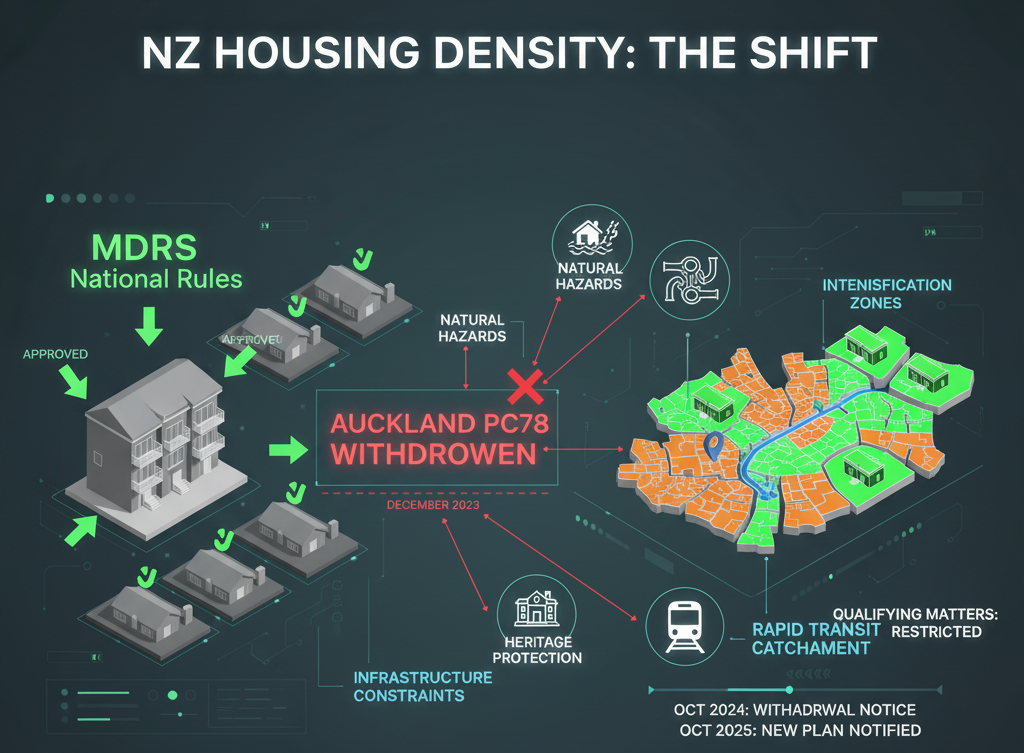
In Auckland, the rule allowing up to three homes of up to three storeys on most residential sites, originally implemented through Plan Change 78 (PC78), is currently in a state of significant flux. Auckland Council has been given permission by the national government to withdraw PC78 and is now developing replacement rules that will provide the council with more localised control over intensification.
Why Auckland’s Rules Are Changing:
This shift in Auckland’s approach is driven by several critical factors:
- Government Direction: In December 2023, the new coalition government announced it was allowing Auckland Council (along with other Tier 1 councils) to withdraw all or part of Plan Change 78. This marks a significant policy shift away from mandatory national density rules towards empowering local councils with greater control over where and how intensification occurs.
- Natural Hazard Concerns: Following the severe flooding events of early 2023, it became unequivocally clear that parts of Auckland are highly vulnerable to natural hazards and therefore unsuitable for high-density development. The council is developing its new plan change to explicitly address these critical risks.
- Infrastructure Issues: Auckland Council has consistently highlighted concerns about the insufficient capacity of existing infrastructure (including water, wastewater, and transport networks) to adequately support the widespread, large-scale intensification that PC78’s original blanket application would have mandated.
Current Status for Developers and Homeowners in Auckland:
- Operative Auckland Unitary Plan: The existing, operative rules of the Auckland Unitary Plan continue to apply. These rules currently govern density, heights, and setbacks in residential zones, including the Mixed Housing Urban (MHU) and Mixed Housing Suburban (MHS) zones.
- PC78 Withdrawal Deadline: Auckland Council has until October 10, 2024, to give public notice of its full or partial withdrawal of Plan Change 78.
- Replacement Plan Change Development: The council is now tasked with developing a new plan change. This replacement must still provide the same overall quantum of housing capacity for Auckland but will allow for significantly more local control over precisely where that density can be located, taking into account local conditions and qualifying matters. This new plan change must be publicly notified by October 10, 2025.
- Development Planning Caution: It is highly risky to base development plans on the assumption that PC78 will proceed as originally written. Developers and homeowners should not rely on the density provisions as initially proposed under PC78.
Upcoming Proposed Zone Changes: Local Context through “Qualifying Matters” (Part 120)
The government’s framework, particularly through Section 120 of the Enabling Housing Supply Act, allows councils to identify “qualifying matters.” These enable them to apply different, potentially more restrictive rules than the blanket MDRS in specific, justified areas.
These “qualifying matters” must be robustly justified and can include:
- Matters of national importance (e.g., outstanding natural landscapes).
- Significant infrastructure constraints.
- Natural hazards (e.g., floods, landslides, coastal erosion).
- Protection of historic heritage areas.
- Areas of ecological or cultural significance to Māori.
- Sensitive transport corridors.
Auckland’s upcoming replacement plan change will heavily incorporate these “qualifying matters,” leading to:
- Increased Local Discretion: Greater ability for Auckland Council to tailor density requirements to specific local contexts, potentially protecting sensitive or constrained areas.
- Community Input: Renewed opportunities for communities to voice concerns and influence how density is managed in their specific neighbourhoods.
- Hybrid Approach: The likely outcome is a more nuanced approach, encouraging higher density in well-serviced areas while applying appropriate limits in areas identified with critical constraints or values.
What You Need to Know for Development in Auckland:
Anyone planning a residential development in Auckland must urgently consult the latest rules and pending plan changes on the Auckland Council website or seek advice from a professional planning consultant. The specific rules for any given property will depend on its current zoning under the operative Unitary Plan and any relevant “qualifying matters” that may limit density in that particular area.
The landscape for urban development in Auckland is dynamic and undergoing significant revision. Staying informed and seeking expert advice is paramount to navigating these evolving regulations successfully.
Disclaimer:
The information provided in this article is general in nature and should not be considered as legal, financial, or professional advice. Buyers/sellers are strongly encouraged to seek independent legal and/or financial advice from qualified professionals before making any decisions related to property transactions.


Join The Discussion